
Round or oval? Start with proportions
A round face usually reads closer to equal length and width, with a soft jaw. An oval face usually reads a little longer, with a gently tapering jaw. These are styling descriptions, not fixed biological categories. Compare your proportions across several well-matched photos, and use hair texture, density and your preferred outline to choose a cut.
Compare the outlines
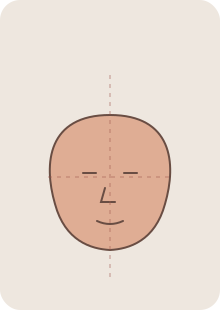 Round outline
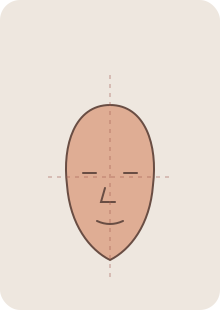 Oval outline
| Look at | Round tendency | Oval tendency |
|---|---|---|
| Length relative to width | Closer to equal | A little longer |
| Jaw outline | Soft, rounded transition | Gentle taper toward the chin |
| Best next question | Where do I want height or length? | Where do I want volume or movement? |
Measure consistently
The free face-shape tool compares upper-forehead-to-chin length, forehead width and jaw width with cheekbone width. Its top point is below the hairline, so its ratios are not interchangeable with a tape measurement from the hairline. Do not compare its number to an unrelated online cutoff.
Why the answer changes between photos
A camera above eye level, a small head turn, an open mouth, or a close lens can change the apparent proportions and detected points. Near a tool threshold, a small ratio change can switch the label. Retake with the photo checklist, compare the ratios, and avoid treating the label as a certainty.
Choose by the effect you want
If you want a longer outline, explore the round-face hairstyle guide. If you want to keep a balanced outline and choose by texture, explore the oval-face guide. Both include original cut diagrams and questions for a stylist. Neither face shape needs fixing.