
Hairstyles for oval faces: choose by hair, not shape
A face reads oval when it is a little longer than wide, with a forehead slightly wider than a jaw that tapers gently to a rounded chin. Because no dimension strongly dominates, most cuts sit well, so the choice usually comes down to hair texture, hairline, density and upkeep. The things to watch are extremes: a very tall top lengthens, and a heavy blunt fringe shortens.
What “oval” means in proportions
A face reads oval when its length is somewhat greater than its width across the cheekbones, the forehead is slightly wider than the jaw, and the jaw tapers gently into a rounded chin. No line is sharply angular and no dimension dominates. Most faces are a blend, and many that read oval lean a little long, round or heart-shaped; the proportions guide explains how to tell which way.
Styling guides often use oval as a reference shape because its proportions sit near the middle of the range, not because it is better. In practice it means hair has less to balance, so the other pages’ maps of where to add or remove volume matter less here, and the hair itself matters more.
What decides the cut instead
| Factor | What it changes | What to ask for |
|---|---|---|
| Fine, straight hair | Falls flat and shows every line of a cut | Blunt ends and shorter lengths that keep body, such as a bob or a short textured crop |
| Thick or coarse hair | Builds width quickly, especially at the sides | Internal layers or texturizing so the shape doesn’t widen |
| Curly or coily hair | Shrinks as it dries, and the volume sits wherever the curls stack | A cut shaped with your natural curl pattern in mind, with length where you want the fullness |
| Cowlicks and hairline | Decide where a fringe or a part will sit | A part and fringe placed with the growth, not against it |
| Upkeep | Short, precise shapes need frequent trims to hold | Longer, layered cuts if you trim rarely |
Cuts for women and men that tend to work
Because the proportions are already balanced, cuts that expose the whole outline tend to work on an oval face, and so do cuts that cover part of it.
- Women: blunt bob at the jaw or chin. On an oval face the line rarely lands on a dominant width, so a precise bob tends to sit cleanly.
- Women: pixie or pulled-back styles. Showing the full outline usually keeps the balance, and the brows carry more of the frame.
- Women: long layers with a center part. The symmetry of a center part rarely exaggerates length or width on a face that is only a little longer than wide.
- Men: buzz cut or crew cut. Very short cuts show the head shape more than the face shape, so they depend on the head as much as on the face.
- Men: slicked-back or longer swept-back hair. Showing the forehead tends to work when the forehead is only slightly wider than the jaw.
- Men: textured quiff. Moderate height works; it is only very tall versions that start to lengthen.
Fringes, brows and beards for an oval face
Fringe. Almost any fringe can work, so let your hairline and cowlicks decide. A heavy blunt fringe covers the top of the forehead and shortens the face, which can tip an oval face toward reading round.
Brows. Following your natural brow line usually keeps the balance. Heavy over-plucking or a very high arch shifts how the eye area reads more than it would on a face with stronger lines elsewhere.
Beard. Most beard styles work. The things to watch are a beard that grows much longer at the chin, which lengthens, and one that is much fuller at the cheeks, which widens.
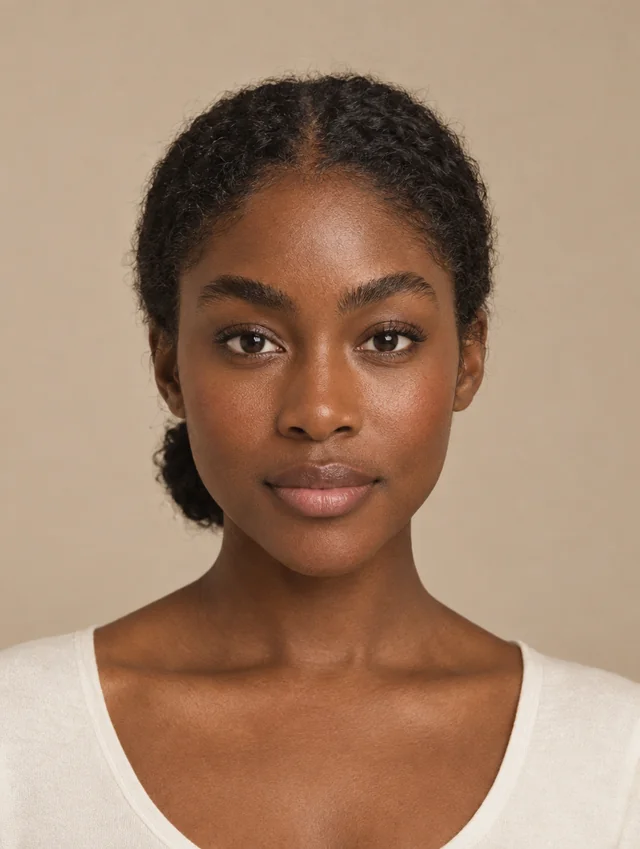 Pulled back, fuller brow
The extremes to watch
- A very tall top, such as a high pompadour or a teased crown, which pulls the face toward reading long.
- A heavy blunt fringe combined with fullness at the cheeks, which pulls it toward reading round.
- Large volume right at cheekbone height, which widens the middle of the face.
A face that reads oval in one photo can read longer or rounder in another, because camera distance and angle change proportions. If you are comparing photos, use the setup in how to take face scan photos so the difference is the hair and not the camera.
Preview before you cut
With fewer proportion rules to lean on, a preview is the quickest way to narrow the options. Try On will render hairstyles on your own front photo once renders are switched on, labeled as AI renderings; a rendering shows a look, not a promise of the result, and it is never used in a score.
If your face sits between oval and another shape, the free face shape tool measures three proportions from one front photo in your browser; the photo isn’t uploaded.
Common questions
What haircut suits an oval face?
Most cuts tend to suit an oval face because no dimension strongly dominates, from a pixie or a blunt bob to long layers, and for men from a buzz cut to longer, swept-back hair. Choose by hair texture, hairline and upkeep, and be careful with extremes such as a very tall top or a heavy blunt fringe.
Is an oval face the best face shape?
No face shape is better than another. Oval is often used as a reference in styling guides because its proportions sit near the middle of the range, so hair has less to balance. That makes choosing a cut simpler; it doesn’t make the face better.
Can an oval face wear a center part?
Usually, yes. A center part frames the face symmetrically, and on a face that is only a little longer than wide with a gently tapering jaw, that symmetry rarely exaggerates length or width. If the face leans long, waves at the sides keep the part from pulling the look downward.