Try it in thirty seconds.
One photo, no account. Real measurements — facial thirds, skin texture, symmetry. Measured in memory and discarded; nothing stored.
167+ exact measurements. Reference-backed context matched to your demographics. Weekly skin checks compare against your own baseline. No attractiveness rating — not now, not in a future update, ever.
 measured & discarded
skin texture
0.31 idx
jaw width ratio
1.31
canthal tilt
+4.2°
the difference
A 7.2/10 that changes with the lighting isn’t information — it’s theatre. Every number here has a unit, a method, and a known error bar. Where we can’t defend a number, we don’t show it.
what rating apps dofig. a
what maxxlook doesfig. b
“A number we can’t defend is worse than no number.”— the product rule
how it works
demo · a real preview, replayedA replay of the free preview: the photo is measured for facial thirds, symmetry, jaw-to-face ratio, and canthal tilt, then a baseline is established.
One photo, no account. Real measurements — facial thirds, skin texture, symmetry. Measured in memory and discarded; nothing stored.
Six guided photos become 167+ measurements across 12 sections — scored against reference ranges matched to your demographics, shown as exact values where no reference exists. Released automatically, no queue.
Weekly skin checks compare against your own baseline, habit reminders land at your local morning, and re-analysis says what changed — and what didn’t.
day 1 → day 30 · example
the scores
A score isn’t a grade and it isn’t a rank. It answers exactly one question: where does this measurement fall on the reference distribution for people like you? Try it:
Score explorer · interocular-to-face-width · female 18–39 · n=1,019
Drag the measurement. The score is just “where does this fall on the reference distribution?” — 50 is the middle, not a passing grade. Every report states which reference was used, its sample size, and what it does not cover.
measurements currently carry reference-backed scores. The rest ship as exact values — including every skin metric, because uncontrolled lighting would make those baselines a guess.
faces behind the pilot references. Measured by this exact pipeline over an openly licensed corpus (FairFace, CC BY 4.0), frontal-pose gated, per sex × age × ethnicity. Derivation documented; cohort data replaces it as users accumulate.
attractiveness ratings, ranks, or percentiles. Not withheld temporarily. Refused structurally — there is no code path that produces one.
measured twice
Under-eye shadowing · weekly checks · example± noise floor
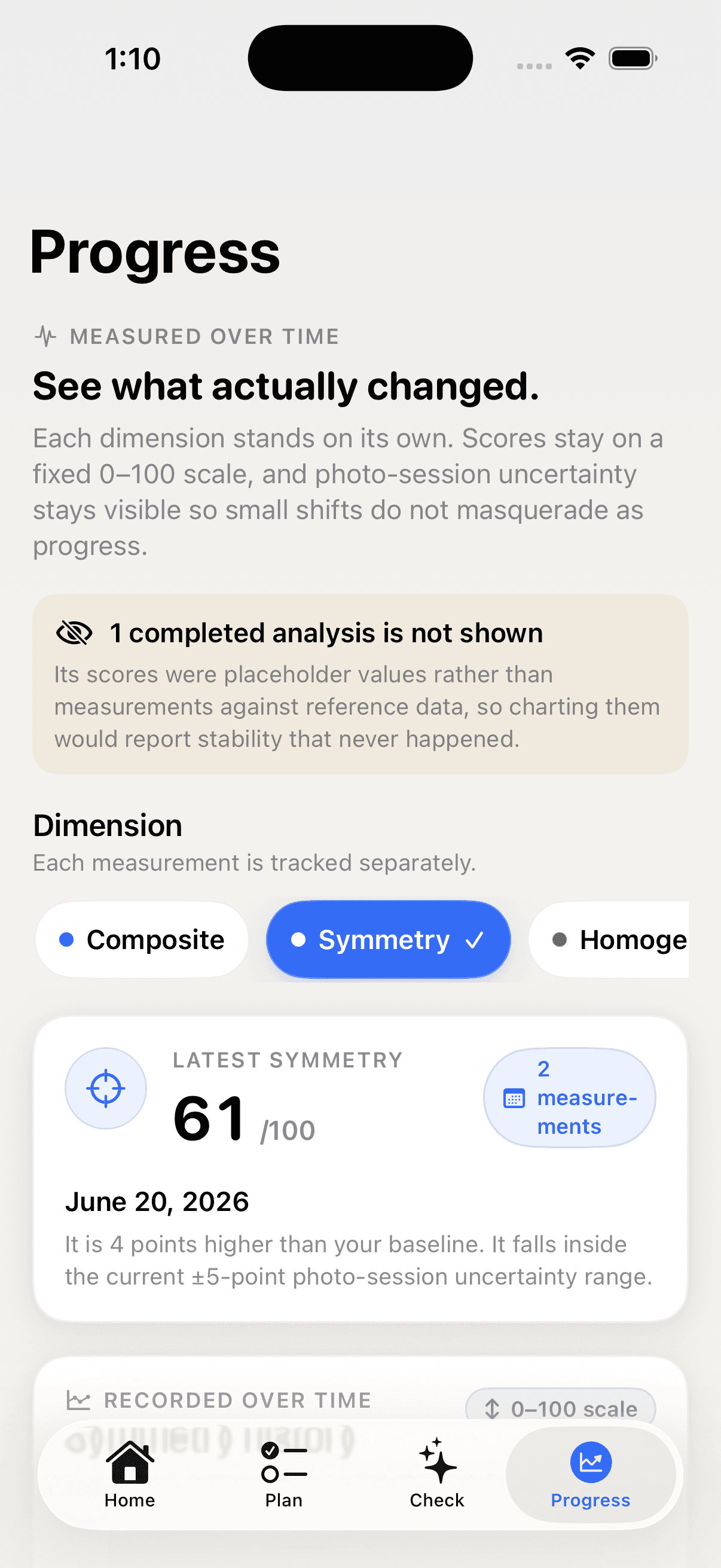
Photos vary between sessions — lighting, distance, compression. So every metric carries a minimum detectable change, derived from controlled perturbation tests and published next to wherever it’s used. Below the floor, we say so:
the rules
membership
Start with the free preview. Upgrade when you want the full picture — on the web, or subscribe in the iPhone app.
$9.99/month
Billed monthly. Cancel anytime.
The free preview needs no account and no payment — try it first.
A measurement instrument with a plan attached. Not a promise about your appearance: no step is sold as guaranteed to change anything, and no score is tuned to flatter or frighten you into renewing.
Six-angle guided capture
Front, profiles, quarters, and smile — quality-checked live, so the numbers start fair.
Automatic release, no queue
The pipeline is the only reviewer. Your report arrives the moment it’s done — typically within the hour.
Cancel anytime
Read-only access to existing reports remains after expiry. Your data stays deletable, in-app, permanently.
questions
One photo, thirty seconds, no account. You get honest raw measurements — facial symmetry, facial thirds, skin texture — with the framing they deserve: exact values, not a rating. The photo is measured and discarded. Nothing is stored.
Your report is generated automatically the moment your measurements finish — typically within an hour of submitting a usable six-photo set. There is no review queue: the pipeline is the only reviewer, and it releases your report the moment it is done.
No rating and no rank — ever. maxxlook will never show you a number that rates or ranks your face. What you get instead: 167+ exact measurements, 0–100 context next to each one that has a matching reference range for your age, sex, and ethnicity (50 is the middle of that range, not a passing grade), and exact values where no reference exists. Uncertainty is visible throughout.
We measure, we don’t assert: the same pipeline that scores your photos was run over a large openly licensed face-image corpus (FairFace, CC BY 4.0), keeping only near-frontal faces, to build each demographic group’s distribution. Skin and smile measurements stay exact-value-only until baselines exist under controlled capture conditions. The full derivation is on our transparency page.
No. maxxlook does not diagnose conditions and is not a substitute for a physician or dermatologist. It is an appearance-focused measurement and habit-planning tool for adults 18 and older.
The $9.99/month plan includes weekly skin checks (the primary way to track change over time), your initial six-photo analysis with a 12-section report and downloadable PDF, a four-month practical habits plan with adherence tracking, and habit reminders timed to your timezone.
Analysis photos are encrypted in transit and at rest. Skin-check photos and free-preview photos are measured in memory and discarded — never stored. You can withdraw biometric consent or delete your account from inside the app at any time.
Weekly skin checks are a single front-facing selfie, measured in memory and discarded — never stored. The pipeline extracts 9 skin metrics (texture, evenness, moisture-visible roughness, redness, pigmentation, eye-area, forehead, periorbital, and smile) and compares them to your own previous readings. Because they track change against your own baseline rather than a population, the numbers are the most defensible in the app. Results classify each change as improved, worsened, or within noise — with the noise floor stated upfront.
Every number ships with its context: measurements that cannot be made from your photos are marked unmeasured rather than guessed, each score states which reference range it used and how large it was, and changes below a measured noise floor are called out as "within noise". The full breakdown is on our transparency page.
free · 30 seconds · nothing stored
One photo, honest numbers, no account. The full analysis waits behind a decision — not a guess.